
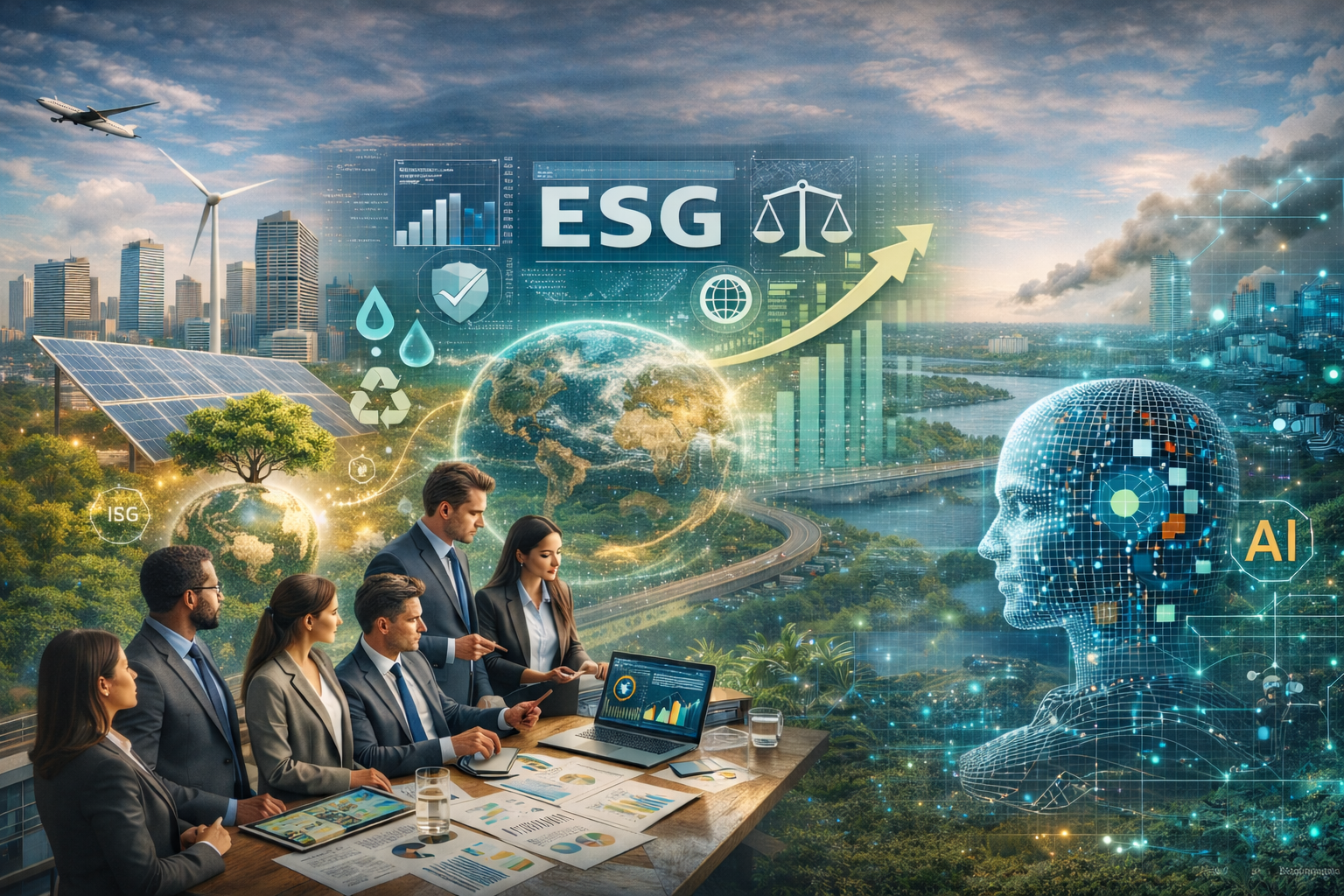
As we move into 2026, ESG is clearly entering a more mature and demanding phase. The focus is shifting away from high-level commitments and ambition statements toward measurable outcomes, accountability, and deep integration into core business models and market infrastructure.
ESG is no longer a parallel sustainability exercise or a compliance-driven reporting task. It is becoming a central lens through which organisations manage risk, strengthen resilience, and create long-term value.
Key trends shaping the next stage of ESG
Standardisation and mandatory disclosure
Global convergence around standards such as IFRS S1 and IFRS S2, aligned with the framework of the ISSB, is significantly raising expectations around consistency, data quality, and comparability. ESG disclosures are increasingly treated with the same rigor as financial reporting, including stronger governance and assurance.
ESG as a risk and resilience agenda
Climate, social, and governance risks are being systematically embedded into enterprise risk management, strategic planning, and capital allocation. ESG is no longer viewed as a standalone sustainability topic, but as a core component of business continuity and long-term competitiveness.
Climate beyond carbon
Beyond emissions reporting, organisations are expanding their focus to include transition risks, physical climate risks, and nature-related impacts. Biodiversity, ecosystems, and natural capital considerations are becoming integral to understanding supply-chain resilience and operational exposure.
Market integrity and trust
In capital markets and financial market infrastructures, ESG is closely linked to transparency, disclosure quality, ethical conduct, and the credibility of sustainable finance instruments. Regulatory scrutiny and investor expectations around greenwashing are intensifying, making trust and integrity central ESG outcomes.
Data, technology, and AI
Automation, advanced analytics, and AI-driven tools are becoming essential for managing ESG data at scale, improving audit readiness, and supporting informed decision-making. Without strong digital foundations, ESG ambitions will be increasingly difficult to operationalise.
People and culture
Strong governance frameworks, effective speak-up mechanisms, and ESG competencies across organisations remain critical enablers of sustainable performance. Ultimately, ESG success depends not only on policies and metrics, but on organisational culture and leadership accountability.
Conclusion: ESG as a driver of long-term value
In 2026, ESG is less about reporting for its own sake and more about how sustainability strengthens markets, institutions, and long-term value creation. Organisations that treat ESG as a strategic and operational discipline—rather than a compliance obligation—will be best positioned to succeed in an increasingly complex and transparent business environment.
“What gets measured gets managed — and increasingly, what gets disclosed gets valued.”
Michael R. Bloomberg, founder of Bloomberg L.P.
#ESG #ESGTrends2026 #SustainableFinance #CapitalMarkets #Governance #ClimateRisk #IFRSS2 #ISSB #SustainabilityLeadership
