
Quantify the Carbon Footprint of Your Organization
Transparent, verified and internationally comparable greenhouse gas information.
GHG Accounting provides a structured and standardized calculation of your organization’s greenhouse gas emissions across the entire value chain — from direct fuel use to purchased energy and supply chain impacts. It enables you to track emissions, meet regulatory and ESG requirements, set reduction targets, and demonstrate climate responsibility to customers and stakeholders.
What is GHG Accounting?
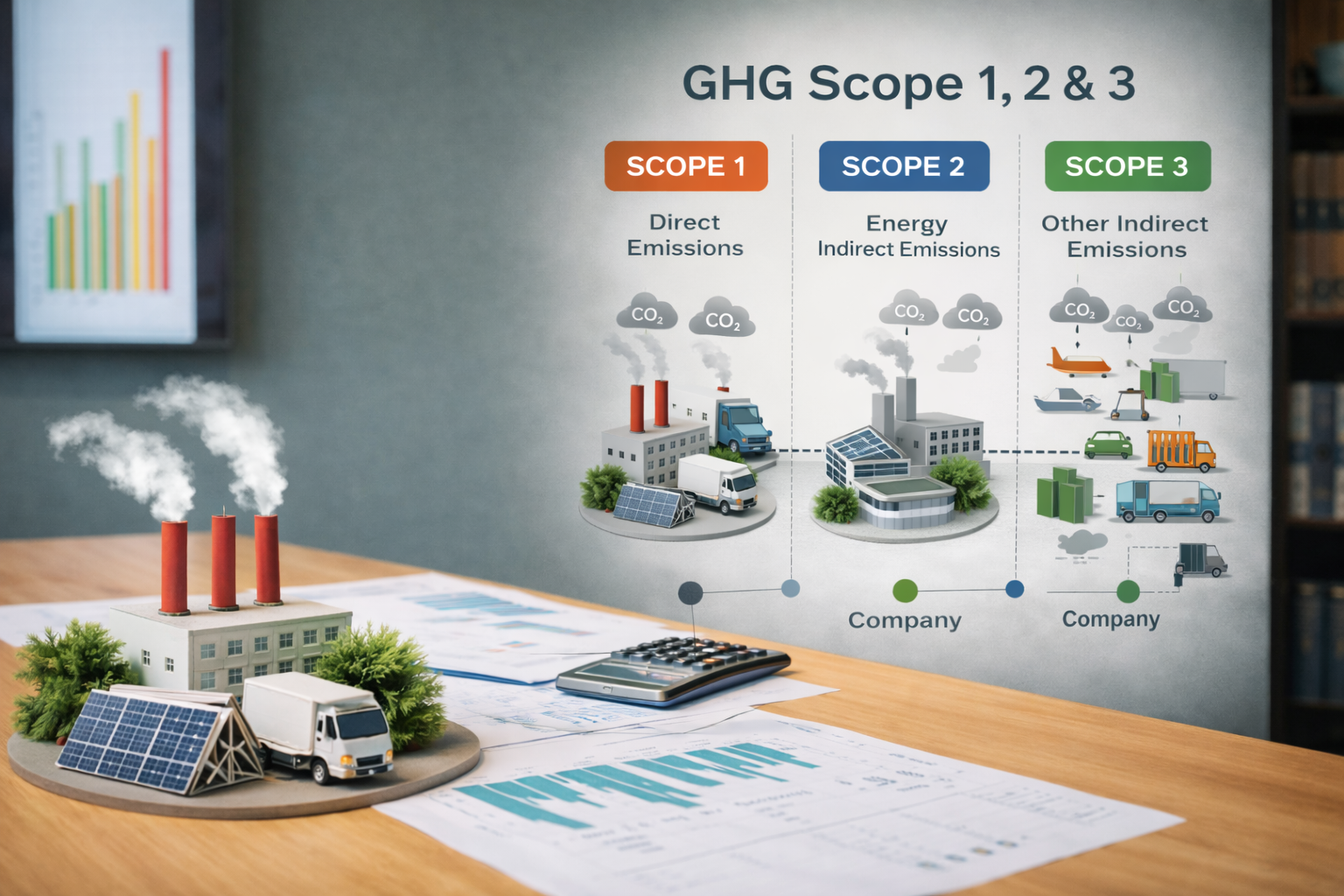
GHG Accounting is a methodology based on the GHG Protocol that measures and reports greenhouse gas emissions in three categories:
Scope 1 – Direct emissions
Emissions from sources owned or controlled by the organization (fuel use, company vehicles, process emissions, refrigerants).
Scope 2 – Indirect energy emissions
Emissions from purchased electricity, heat, or cooling.
Scope 3 – Value chain emissions
All other indirect emissions across the upstream and downstream value chain (suppliers, transport, waste, business travel, product lifecycle).
Why GHG Accounting matters?
-
Ensures compliance with CSRD, ESRS E1, and climate regulations
-
Provides a clear baseline for decarbonization
-
Identifies major emission hotspots (energy, transport, supply chain)
-
Improves transparency for customers, investors, and partners
-
Supports carbon reduction targets and Net Zero strategy
-
Strengthens ESG performance and reporting credibility
Digital GHG Accounting solution
Our digital GHG Accounting solution enables:
-
Automated Scope 1, 2, and 3 calculation
-
Integration with energy, ERP, and production data
-
Emission factor database (IPCC, DEFRA, IEA)
-
Real-time emission tracking and dashboards
-
Audit-ready and CSRD-aligned reporting
-
Scalable calculation from site level to product footprint (PCF)
Know your GHG Emissions
Demonstrate the Environmental Impact of Your Organization
GHG accounting in line with GHG Protocol and ISO 14064-1, providing transparent and verifiable carbon reporting across Scope 1, 2, and 3. Supports CSRD / ESRS requirements, Net Zero strategies, and climate disclosure frameworks.
Contact us for an introductory consultation or proposal.
Measure and Manage Your GHG Emissions
Set Boundaries & Gather Data
Define organizational boundaries and identify emission sources across Scope 1, 2, and relevant Scope 3. Collect reliable data on fuel, energy, transport, materials, and waste to ensure accuracy and traceability.
Calculate Emissions
Convert activity data into t CO₂e using recognized emission factors (IPCC, DEFRA, IEA). Calculate Scope 1, Scope 2 (location & market-based), and screen key Scope 3 categories to obtain a complete carbon footprint.
Analyze & Verify
Validate results in line with GHG Protocol / ISO 14064-1. Identify emission hotspots, generate KPIs, and prepare an audit-ready dataset for CSRD / ESG reporting. Optional third-party verification available.
Report & Reduce
Publish the annual GHG inventory, set reduction targets, and implement a decarbonization roadmap. Track progress yearly and integrate results into ESG, Net Zero, and digital DMA/DPP systems.
